Homeschool Science: Atoms and Nuclear Science
Inside the tiny particles that make up everything around us is a world of science that helps explain everything from how matter behaves to how we produce energy. Exploring atoms is a wonderful way to spark curiosity in your homeschool science. The air we breathe, the water we drink, the food on our tables, and even the pages of our favorite books are all made of atoms—tiny building blocks too small to see with the naked eye. You don’t need a complicated laboratory or advanced science equipment to get started. A few simple activities can introduce your children to atomic structure and open the door to bigger questions about nuclear science.
Nuclear Science: Meet the Atom
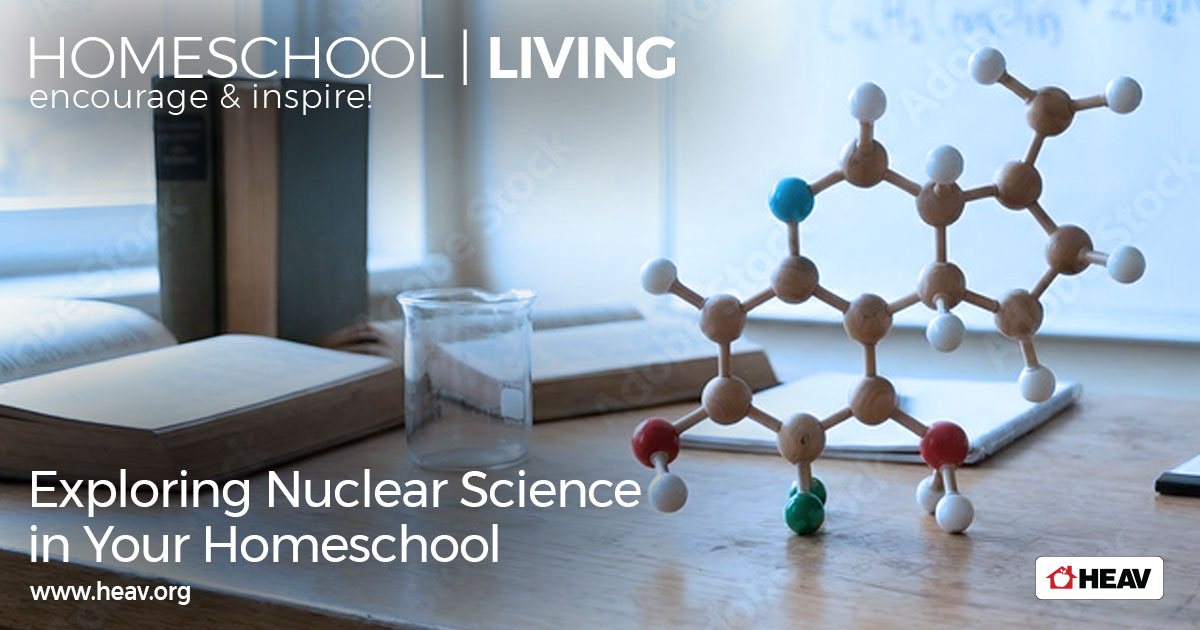
Atoms might be small, but their structure is fascinating. At the center is a nucleus made of protons and neutrons, while electrons orbit around it. Different combinations of these tiny particles make up the elements that form all the matter around us.
A hands-on model can make this invisible world a little easier to imagine. Kids Activities Blog offers a simple Build Your Own Atom Model activity that lets children create a visual representation of an atom. Gather a few basic craft supplies, talk about the different particles, and let your children build their own model. Younger learners can focus on identifying the parts, while older students can explore how the number of protons determines an element’s identity.
If you’re looking for even more inspiration, A Magical Homeschool has gathered a treasure trove of fun and free ways to learn about atoms. You’ll find games, songs, printable activities, and even edible models—so many playful ways to explore and experiment together.
From Tiny Particles to Powerful Energy
Once you’ve explored the basics of atoms, you can start to peek into the world of nuclear science. Nuclear science focuses on the nucleus of the atom and the energy and changes that take place there. Scientists use this knowledge in many fields, including electricity generation, medicine, technology, and space exploration.
This is where your homeschool science study can really grow alongside your children. Younger kids might enjoy exploring different forms of energy and discovering how electricity powers the things they use every day. Older students can dig deeper into topics like nuclear fission, radiation, and how nuclear power plants make electricity. You can also discuss the benefits, challenges, and safety questions that come with using nuclear technology.
This year, Nuclear Science Week, an annual celebration of nuclear science and its many applications, takes place October 19–23, 2026. Check out the website for a collection of educational resources, videos, activities, and lesson plans to help students discover how nuclear science connects to energy, health care, engineering, and more.
You might pick one application to explore as a family, then invite your children to share what they’ve learned—maybe through a drawing, a short report, or a family conversation. Where does your home’s electricity come from? How does nuclear science help doctors care for patients? What would your children want to ask a nuclear scientist if they had the chance?
One of the joys of a science study like this is that one question leads to another. Building a simple atom model might spark an interest in the periodic table, a chat about energy could lead to learning about electricity, and curiosity about nuclear science might open up new paths into engineering, medicine, or physics.
You don’t have to have answers to every question at once. Follow your children’s curiosity, and discover together just how much there is to learn about the world we cannot see.

Megan Mora Fuentes
More homeschool inspiration awaits!
Visit our HEAV blog for more homeschool insights, resourceful tips, and encouragement connections.