Summer Homeschool: Sunflower Science
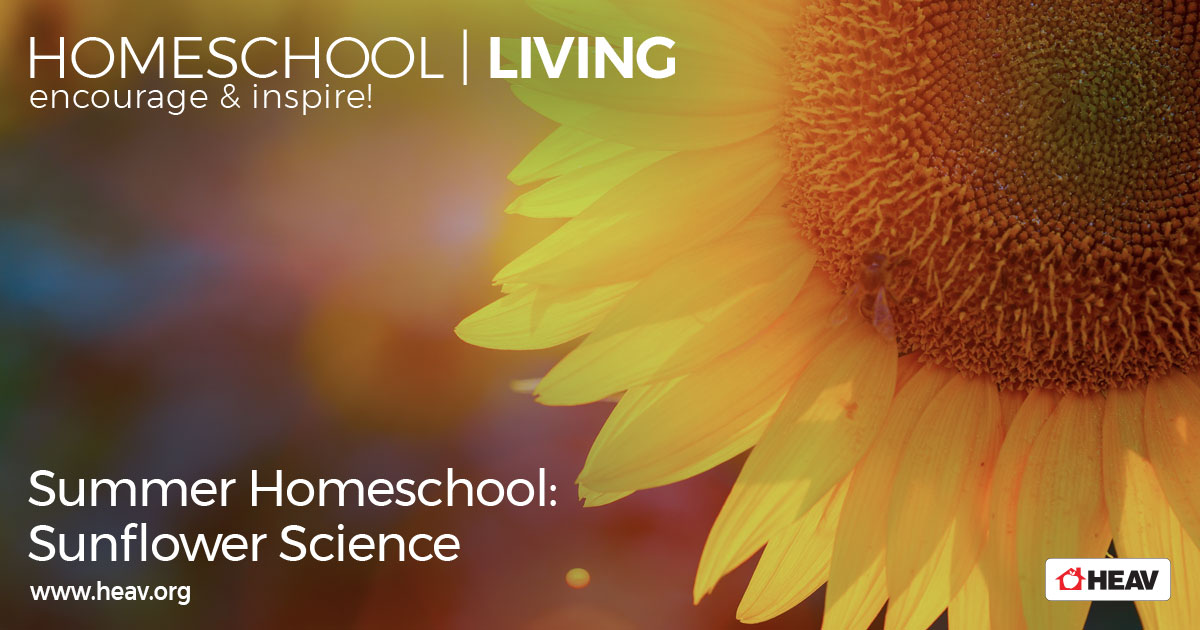
Sunflower science is a great summer activity. Few flowers capture the joy of summer quite like the sunflower. Towering over gardens with bright golden blooms, sunflowers invite us to slow down, look closely, and discover that there’s far more happening than meets the eye. They also make the perfect centerpiece for a week of summer homeschool science that blends botany, math, art, language arts, and even a family field trip.
In fact, if you can’t resist stopping to admire every sunflower you see, there’s even a word for that! A solanthophile is someone who loves sunflowers. The name combines the Latin sol (“sun”) with the Greek philos (“lover”)—a fitting description for anyone drawn to these cheerful summer flowers.
A Living Botany Lesson
Sunflower science is a wonderful continuation of the botany studies you may have started earlier this year. If your students enjoyed exploring how plants respond to light and temperature in this Homeschool Living botany lesson, now is the perfect time to observe those concepts in one of nature’s most recognizable flowers.
Young sunflower buds actually follow the movement of the sun across the sky, a phenomenon called heliotropism. As the flowers mature, however, they settle facing east, where the morning sunlight quickly warms the blossoms and attracts busy pollinators. Watching this process firsthand helps children understand that plants aren’t passive—they constantly respond to the world around them.
One Flower…Or Thousands of Flowers?
At first glance, a sunflower looks like one enormous flower. Look closer, though, and your children will discover an amazing secret.
The large yellow “petals” around the edge are actually individual ray flowers, while the dark center contains hundreds—or even thousands—of tiny disk flowers. Together they form what botanists call a composite flower, with each tiny bloom capable of producing its own seed. It’s an excellent reminder that careful observation often reveals surprising complexity in God’s creation.
Take your summer homeschool study one step further by completing a sunflower dissection. As students carefully separate the flower into its different parts, they’ll gain a better understanding of plant anatomy while strengthening observation and recording skills.
Nature’s Hidden Mathematics
Sunflowers aren’t just fascinating botanically—they’re mathematical marvels, too.
Challenge older students to count the spirals of seeds winding outward from the center. They’ll often discover numbers from the Fibonacci sequence, the famous mathematical pattern found throughout nature in pinecones, pineapples, seashells, and many flowering plants. This simple activity naturally blends botany with mathematics while encouraging students to look for patterns throughout creation.
Younger children can practice counting seeds, estimating the height of plants, measuring stem growth, or graphing sunflower heights throughout the season.
Bring Your Nature Journal
Whether you’re growing your own sunflowers or visiting a local field, encourage each child to keep a nature journal.
Sketch different stages of growth. Record pollinators that visit the flowers. Write descriptive words inspired by the colors, textures, and scents. Older students might research why sunflowers are such valuable food sources for birds and beneficial insects, while younger learners can simply practice careful observation through drawing.
These simple activities reinforce one of homeschooling’s greatest strengths: learning to notice the world around us.
Take a Virginia Sunflower Adventure
Late summer is sunflower season across Virginia, making it the perfect excuse for a summer homeschool field trip. Many farms throughout the Commonwealth open their sunflower fields for families to explore, photograph, and enjoy together.
A visit to a sunflower field can easily become an entire day of learning. Practice photography, identify insects, discuss pollination, estimate field sizes, calculate travel distances, or simply enjoy spending time outdoors together while surrounded by thousands of brilliant blooms.
Growing Wonder
One of the greatest gifts of homeschooling is the freedom to follow curiosity wherever it leads. Your sunflower science lesson can inspire learning in math, art, writing, and nature study—all while creating memories your children will carry long after summer ends.
So whether you plant a packet of seeds in your backyard, dissect a blossom on your kitchen table, or spend a sunny afternoon wandering through a Virginia sunflower field, don’t miss the opportunity to let these remarkable flowers remind your family that meaningful learning often blooms in the simplest places.

Megan Mora Fuentes
Enjoy this article?
For more insightful homeschool related articles, living tips, and encouraging connections, visit our HEAV blog.