Winter Sky Homeschool Science: Northern Lights
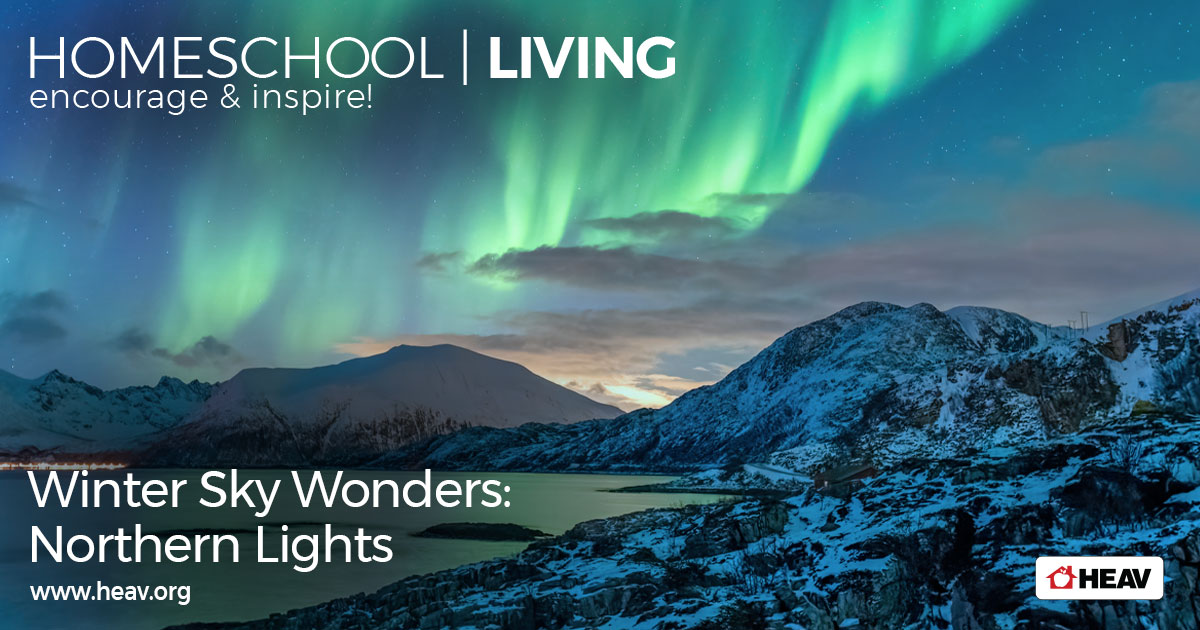
Have you ever noticed how, in a clear winter sky, the stars seem to shine just a bit brighter? Familiar constellations pop out against the darkness, and sometimes, if the conditions are just right, colorful ribbons of light dance across the horizon. The northern lights are one of nature’s most breathtaking displays, but there’s so much more to them than just their beauty. Check out this Homeschool Living for inspiration for your own homeschool science studies, and explore the amazing phenomenon happening high above our heads.
What Makes the Northern Lights Glow?
The northern lights, or aurora borealis, begin with activity on the Sun, as it constantly releases a stream of tiny charged particles called the solar wind. When these particles reach Earth, they meet our planet’s magnetic field, and some are guided toward the upper atmosphere where they collide with gases like oxygen and nitrogen. Each collision releases a bit of energy as light, creating the beautiful auroras we see in the sky.
The colors can vary depending on which gases are involved and how high in the atmosphere the collisions occur. Oxygen often gives us green or red light, while nitrogen can create beautiful shades of blue, purple, and pink.
NASA’s Auroras resource explains how the Sun and Earth work together to create this natural light show. Explore the photographs and explanations with your children, and see if they can describe the journey from the Sun to the colorful lights in the sky. Older students might investigate solar wind, magnetic fields, and the different gases responsible for aurora colors.
A Winter Sky Nature Study
You don’t need to travel all the way to the Arctic to enjoy a nature study inspired by the northern lights. While auroras are most commonly visible near Earth’s polar regions, strong solar activity can sometimes make them visible much farther south. Even when the lights aren’t visible in your area, you can explore the science and beauty of this phenomenon through observation, art, and hands-on activities.
Homeschool Nature Study offers northern lights nature study activities with ideas for learning about auroras, exploring magnets and Earth’s magnetic field, and creating nature-inspired artwork. You might also try creating your own northern lights artwork. Use chalk pastels, watercolor, or colored pencils to blend greens, blues, purples, and pinks across a dark sky. As you create, talk with your children about the colors they see in real aurora photographs and what causes them. Younger children can focus on blending colors and describing their pictures, while older ones might enjoy labeling the layers of the atmosphere or explaining how auroras form.
Make the Night Sky a Homeschool Science Classroom
The northern lights can be just the beginning of a much bigger adventure in exploring the night sky. Winter evenings are perfect for looking for constellations, watching the Moon, spotting bright planets, and noticing how the stars seem to shift as the seasons change.
HEAV’s Homeschool Astronomy resource offers ideas and encouragement for bringing astronomy into your homeschool science. Use it to expand your study beyond auroras and help your children become more familiar with the wonders overhead.
You might enjoy starting a family sky journal. Record the date, weather, Moon phase, and any stars or constellations you can identify. Sketch what you see, and come back to your journal throughout the season to notice what’s changed. You don’t need a telescope to get started—just a clear view of the sky and a bit of curiosity.
The northern lights remind us that some of the most extraordinary science happens beyond our everyday view. Whether your family gets to see an actual aurora or simply explores one through your homeschool science lessons, take a little time this winter to look up together. You might find that the winter sky holds even more wonders than you expected.