
Booker T. Washington
Booker T. Washington was born on April 5, 1856, in a small log cabin in Hale’s Ford, Franklin County, Virginia. Despite his humble and impoverished beginnings, he rose to become one of the most influential African American educators, authors, and orators of the late 19th and early 20th centuries. Washington’s contributions were centered on the belief that economic self-reliance and practical education were the keys to racial advancement. In 1881, he became the first leader of the Tuskegee Normal and Industrial Institute in Alabama. He transformed it from a 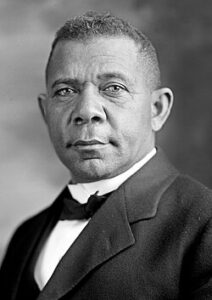 tiny school with no buildings into a world-renowned university that provided vocational training and academic education to thousands of Black students. His 1895 “Atlanta Compromise” speech made him a national figure. He argued that African Americans should focus on industrial education and economic progress rather than immediate social integration, a philosophy that won support from both Northern philanthropists and Southern whites. His autobiography, Up from Slavery (1901), became a classic of American literature, chronicling his journey from a slave cabin to the White House, where he served as an advisor to Presidents Theodore Roosevelt and William Howard Taft. Washington’s legacy remains a cornerstone of American history, representing a bridge between the era of slavery and the modern civil rights movement.
Winsome Earle-Sears
Winsome Earle-Sears has established a historic legacy in Virginia politics by serving as the 42nd Lieutenant Governor from 2022 to 2026. As a Jamaican-born immigrant and U.S. Marine Corps veteran, she broke multiple barriers  as the first female Lieutenant Governor. She was the first Black woman elected statewide, and the first naturalized citizen to hold the office. Her contributions span legislative leadership, education, and community service. As Lieutenant Governor, she presided over the Virginia Senate and frequently cast decisive tie-breaking votes. She served on key boards, including the Virginia Tourism Authority and the Virginia Military Advisory Council, and represented Virginia in the Advanced Air Mobility Alliance. Before her statewide election, she served as Vice President of the Virginia State Board of Education. Throughout her career, she championed parental rights, school choice, and a focus on core academic skills like reading and math. Being a trained electrician and small business owner, Earle-Sears advocated for tax reductions, such as eliminating the car tax, and protecting Virginia’s “right-to-work” status. Her community contributions include leading a men’s prison ministry and directing a women’s homeless shelter. Earle-Sears’ career reflects a commitment to fiscal conservatism and public safety, leaving a permanent mark on the Commonwealth’s political landscape. She was a candidate in the 2025 historical Virginia Governor election, leading Virginia to its first female to hold the position. She was out voted, but remains part of the historical event.
L. Douglas Wilder
L. Douglas Wilder was born on January 17, 1931, in Richmond, Virginia, in the segregated neighborhood of Church Hill. From humble beginnings, he rose through the ranks of Virginia politics to become a figure of national historic significance. Wilder’s contributions to the Commonwealth are defined by a series of historic “firsts” and influential leadership. In 1969, Wilder became the first African American elected to the Virginia Senate since the Reconstruction era. He later became the first African American to win a statewide executive office in Virginia when he was elected Lieutenant Governor in 1985. In 1989, he made history as the first African American in United States history to be elected Governor. During his time in the  General Assembly, he championed the creation of a state holiday honoring Dr. Martin Luther King, Jr., making Virginia the first Southern state to do so. He also advocated for healthcare provisions for sickle-cell anemia, a disease that disproportionately affects Black Americans. As Governor (1990–1994), he was recognized for his fiscal management, successfully balancing the state budget during a difficult national recession. From 2005 to 2009, he served as the Mayor of Richmond, where he oversaw a “strong-mayor” transition and worked to reduce crime and improve city finances. Today, his legacy continues through the L. Douglas Wilder School of Government and Public Affairs at Virginia Commonwealth University, where he has served as a distinguished professor.
Mary Smith Kelsey Peake
Mary Smith Kelsey Peake was born in 1823 in Norfolk, Virginia. As the daughter of a free Black woman and a white Englishman, she received an education in Alexandria before returning to Norfolk and later moving to Hampton in 1847. Despite Virginia laws that prohibited the education of Black people following the 1831 Nat Turner Rebellion, Peake dedicated her life to literacy and humanitarianism. At age 24, she began secretly teaching both 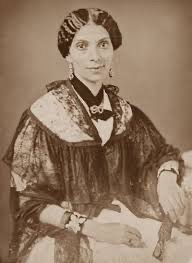 enslaved and free African Americans to read and write. In September 1861, she became the first Black teacher hired by the American Missionary Association (AMA). She famously held her first official classes outdoors under a large oak tree near Fort Monroe, which provided refuge for “contrabands” (escaped slaves). The tree where she taught is now known as the Emancipation Oak, as it was the site of the first Southern reading of the Emancipation Proclamation in 1863. This tree still stands today on the campus of Hampton University, Hampton, VA. Her school eventually moved into “Brown Cottage,” which is considered the first facility of what would become Hampton University. She also founded the Daughters of Zion, a benevolent organization that assisted the poor and sick in the Hampton community. Peake continued to teach even as her health failed, instructing over 500 students before her death in 1862. She was a true pioneer for education of Black Americans in Virginia.